
In this issue of Healthcare Matters, we are pleased to feature HCI as our Quality Management Company of the Month.
 In healthcare, quality and patient safety are ultimately about more than policies, procedures and regulatory requirements. They depend on whether organisations can turn those requirements into consistent, informed action at every level of care. This is the space in which HCI has been operating for more than two decades.
Established in 2005, HCI is a healthcare professional services and digital transformation organisation focused on helping health and social care providers improve quality, patient safety and regulatory compliance. Working with organisations across the public, private and social sectors, HCI combines expertise in clinical and social care, quality, research and healthcare regulation with practical experience of implementing quality management systems.
Its work encompasses many of the fundamental building blocks of effective healthcare governance: quality-of-care audits, policy and procedure development, risk management, incident and complaint investigations, governance reviews, gap analysis, regulatory and accreditation support, as well as education and training. HCI also works with providers to develop and implement Quality Management Information Systems, helping organisations transform the way they collect, manage and use quality and safety data.
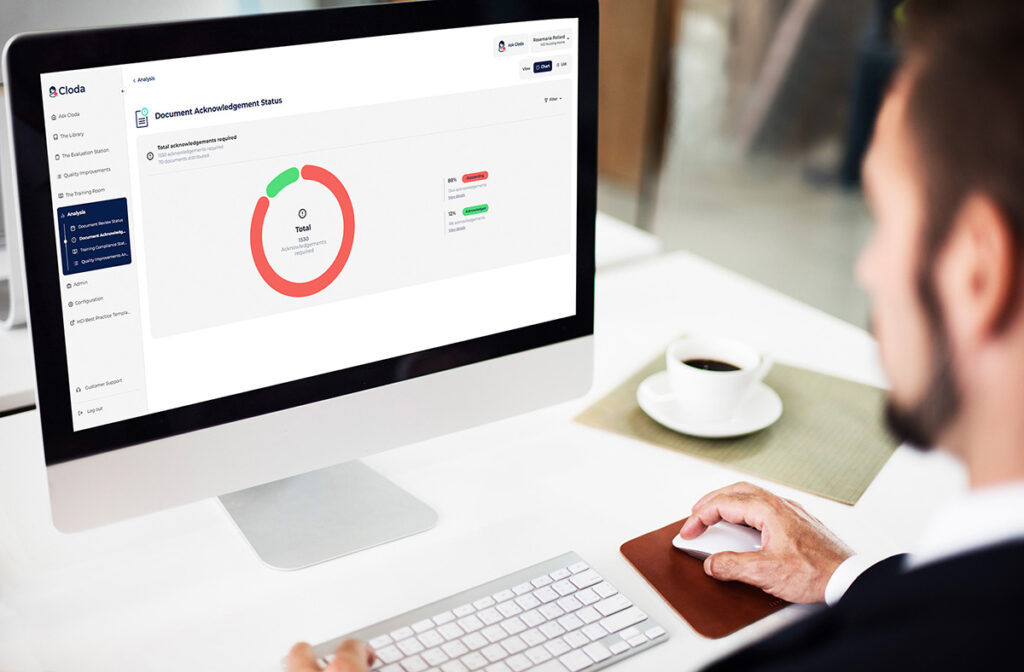
That combination of healthcare expertise and digital capability is central to HCI’s proposition. Rather than treating compliance as an administrative exercise, the organisation’s stated mission is to help providers make intelligence-driven decisions to attain, manage and continuously improve quality, safety and regulatory compliance. Its digital transformation work is designed to give organisations access to real-time governance information across areas such as audits, risks, incidents, documents and training.
It is from this foundation of hands-on healthcare experience that HCI has developed its latest digital proposition: Cloda, an AI-enhanced Quality Management System designed to make quality, compliance and governance more accessible, actionable and embedded in everyday care.
 That evolution is rooted in HCI’s history. The company was founded in 2005 by its CEO, John Sweeney, following a clear recognition of the need to strengthen quality, safety and compliance across health and social care.
“Cloda is the next evolution of HCI’s work,” says Regina Connell, Chief Operations Officer, at HCI. “HCI has spent 20 years supporting health and social care organisations to strengthen quality, safety and compliance. Every feature is shaped by two decades of seeing, first-hand, where quality systems help staff and where the challenges arise.”
Today, HCI is headquartered in Ireland, with operations extending across the UK and Australia. Its focus remains firmly on supporting health and social care providers to deliver safer, higher-quality care – but Cloda represents an opportunity to take that expertise further and make it available at scale.
“Cloda is how we do that at scale,” Connell says. “Cloda is an AI-enhanced Quality Management System, where modules include policies and procedures, training, audits, quality improvement plans and compliance insights, with risk and incident management modules next for deployment.”
For HCI, however, the proposition is not simply about putting artificial intelligence into an existing quality system. The organisation believes the real opportunity lies in changing how healthcare staff interact with quality information in the first place.
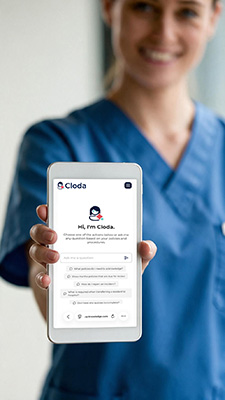
 Traditional Quality Management Systems can require staff to search through multiple documents and manually read policies and procedures to find the information they need. Cloda takes a different approach, allowing staff to ‘Just Ask Cloda’ a question such as ‘How do I report an incident’ and they will receive an immediate answer drawn directly from their organisation’s approved policies and procedures.
HCI sees this practical understanding of the realities of care as one of Cloda’s defining characteristics. Connell describes HCI as ‘a trusted, long-term partner,’ pointing to the longstanding relationships it has developed with quality and safety professionals across the sector.
“Cloda extends that trust into a digital product,” she says, “built by people who understand the regulatory and operational realities of care, not
just the technology.”
That experience is reflected in the breadth of organisations Cloda is designed to serve, from hospitals and nursing and care homes to domiciliary care, supported living, mental health and disability services.
Ultimately, the ambition is straightforward: Cloda’s goal is to simplify compliance, empower healthcare teams, and ultimately, improve patient outcomes.
But what does that difference mean in practice?
“The honest answer is user adoption, because a compliance tool nobody uses isn’t really a compliance tool,” says Connell. Cloda sees user adoption rates of above 80% within six weeks of go-live. It comes down to speed, user-friendliness and accessibility: staff can find the answer to a procedural question in around four seconds with Cloda, compared to roughly 10 minutes searching a traditional system. Across 100 staff, that time saving adds up to more than 500 hours given back to care every year.
Cloda’s Multilingual Digital Assistant means staff can ask a question in their own language and receive the answer in that language, a genuinely practical feature in a workforce as linguistically diverse as health and social care.
 Compliance Insights also adds another layer to this: it gives providers visibility into how staff are actually interacting with their policies and procedures, what types of questions are being asked, where the knowledge gaps sit, and how staff are performing in comprehension quizzes. Instead of finding out about a gap during an inspection, providers can see it forming and act before it becomes a compliance risk.
“Because Cloda is built using a combination of HCI’s 20-plus years of professional services expertise and implementation of Quality Management Information Systems in healthcare organisations, Cloda isn’t guessing at what providers need. We have seen the compliance challenges our clients face every day, and we built a solution to help address them,” says Connell.
Another key feature is Cloda’s availability beyond traditional working hours. The platform is accessible whenever staff need it, with 29% of questions asked outside standard business hours. For frontline teams working around the clock, that access could prove particularly valuable, ensuring quality and compliance information is available when it is needed, rather than only during a conventional nine-to-five working day.
More recently, HCI has expanded Cloda’s capabilities with the launch of The Evaluation Station, its new Audit Management System. The development stems directly from a challenge HCI repeatedly encountered through its professional services work: organisations carrying out internal audits, only for findings and actions to become buried in spreadsheets.
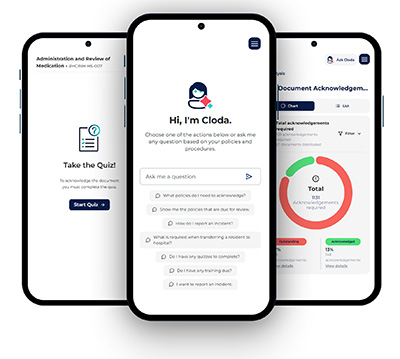 The Evaluation Station brings the complete internal audit lifecycle into one place, from scheduling audits and recording findings to assigning actions and tracking progress and evidence through to completion. As Connell explains, the aim is to ensure ‘an audit finding becomes a tracked improvement, not a forgotten action’ – turning quality assurance into a continuous process of measurable improvement. It also marks Cloda’s move beyond documents and training into the audit and improvement space, a natural next step as HCI builds out its broader quality management offering.
For HCI, the development of Cloda is very much an ongoing journey. While the platform already brings together policies and procedures, training, audits, quality improvement plans and compliance insights, the next stage will see its Quality Management System expand into two further critical areas: risk management and incident management.
These additions will further broaden Cloda’s role within healthcare organisations, bringing more elements of quality and safety management into a single, connected environment. For HCI, however, the ambition extends beyond simply adding new modules. The company is equally focused on developing Cloda’s underlying AI capabilities and making the technology increasingly intuitive for the people who use it every day.
As Connell explains, the objective is to make it ‘progressively easier for frontline staff to engage with the system,’ reducing some of the time and complexity traditionally associated with quality and compliance processes. In doing so, HCI hopes to give healthcare professionals more time to focus on what matters most: delivering care.
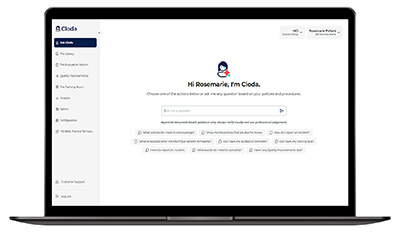 That philosophy reflects a broader view of compliance. Rather than seeing quality management as another administrative burden for already stretched teams, HCI believes technology should make compliance work for the people responsible for delivering safe care.
“Compliance shouldn’t be something staff have to work around; it should work for them,” says Connell. “That’s a main focus for Cloda: helping care providers get real value from their quality management system, and helping frontline staff easily access and understand the procedures that keep service users safe.”
For a sector where effective governance, regulatory compliance and patient safety are intrinsically linked, that is a significant ambition. If Cloda can continue to translate complex quality requirements into accessible, actionable information, its development could represent an important step towards making quality management less about navigating systems and more about supporting better care.
For those interested in seeing how that vision translates into practice, HCI will be showcasing Cloda at Care Show Birmingham on 7th–8th October at Stand F40, where visitors can see the platform in action and learn more about its evolving capabilities.
For more information, please see below:
info@cloda.ai
https://www.cloda.ai/uk
https://hci.care